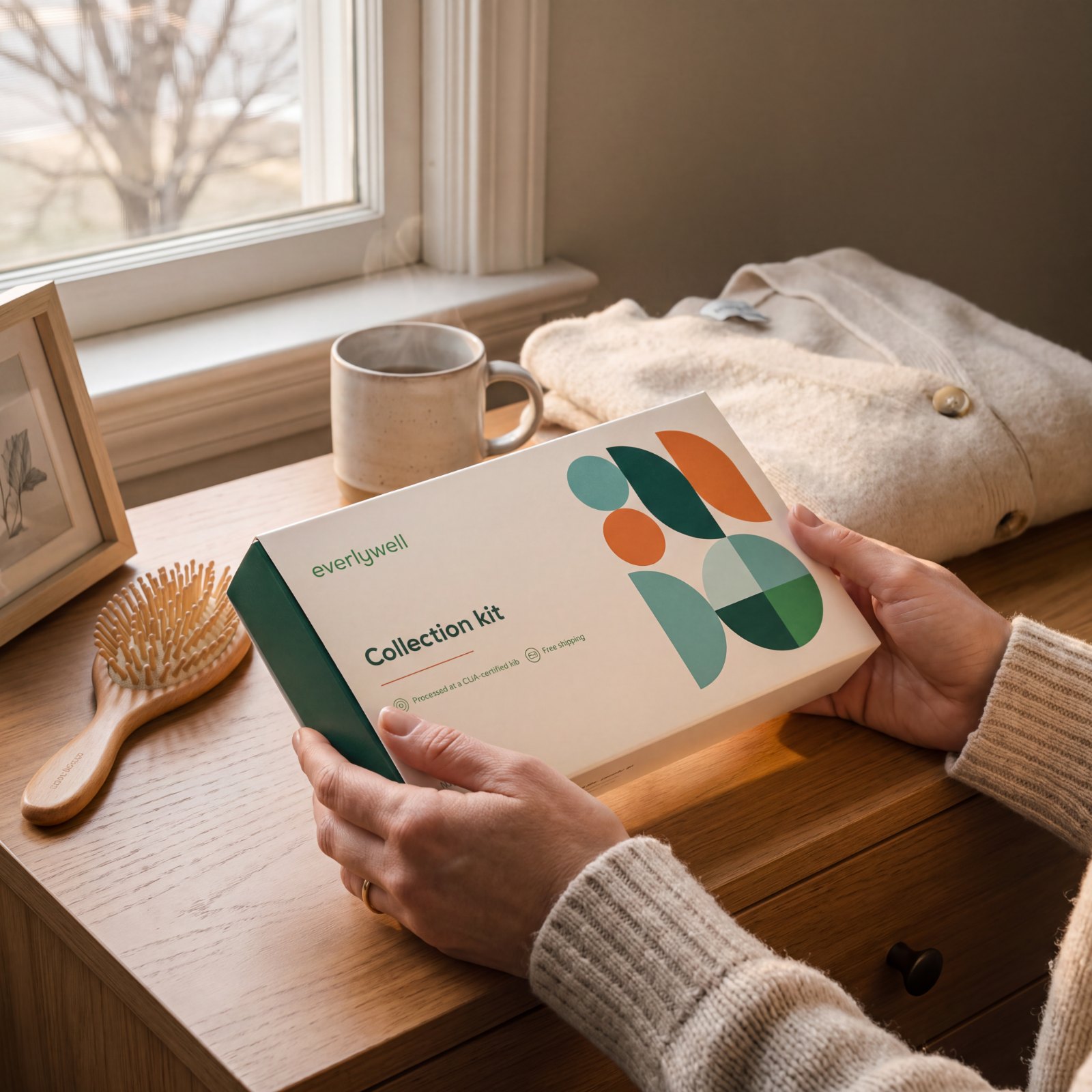
Thyroid Test
TSH, free T3, free T4, TPO from a finger prick
- Free shipping, both ways
- FSA / HSA accepted, or pay over time
- Ships to every state except New York
About this test
Experiencing sluggishness or fatigue, hair loss, weight change, gastrointestinal symptoms, dry skin, or increased sweating? These symptoms could be a sign of thyroid dysfunction, which affects millions of people every day. Measure 4 key thyroid biomarkers in one test to understand your levels, and see if any of them may be keeping you from feeling your best.
- Measures TSH, Free T3, Free T4, TPO Ab
- Finger prick sample
- Prescriptions available

Who should take this test?
Changes in thyroid hormone levels can cause hypothyroidism (underactive thyroid) and hyperthyroidism (overactive thyroid). Both conditions can lead to a variety of uncomfortable symptoms in your body.
Body
- Sluggishness and fatigue
- Thinning hair
- Changes in weight
- Cold intolerance
- Heat intolerance
Mind
- Depression
- Forgetfulness
- Nervousness
- Anxiousness
- Irritability
Gastrointestinal
- Constipation
- Frequent bowel movements
Skin
- Dry skin
- Increased sweating
What does this test measure?
Your test results will measure your levels of 3 main thyroid hormones plus thyroid peroxidase antibodies. These circulating thyroid hormones have an impact on many functions of the body. By measuring the level of each marker, this thyroid function test can help you understand if you may be experiencing thyroid dysfunction.
- Thyroid-stimulating hormone (TSH)
- Thyroid-stimulating hormone, or TSH, is a hormone produced by the pituitary gland that is responsible for controlling the production of the thyroid hormones T3 and T4 by the thyroid gland. The hormone TSH is considered the most sensitive marker for screening for thyroid diseases and conditions.
- Thyroid peroxidase (TPO) antibodies
- Thyroid peroxidase antibodies are antibodies that can bind to thyroid enzymes, suppressing thyroid function. If TPO antibodies are elevated, this could be suggestive of an autoimmune condition. In the case of hypothyroidism, or an underactive thyroid, Hashimoto’s thyroiditis may be the culprit, whereas hyperthyroidism, or an overactive thyroid is commonly caused by Graves’ disease.
- Free T3
- T3 (triiodothyronine) is a hormone produced by the thyroid gland. While it is less abundant than T4, T3 is considered the more active of these two thyroid hormones. Together, these two thyroid hormones help determine the rate at which every cell in the body uses energy. Levels of T3 fluctuate when individuals have an under- or overactive thyroid gland. This test measures free T3, the free (not bound to protein), and biologically active form of the hormone.
- Free T4
- T4 (thyroxine) is the predominant hormone produced by the thyroid gland. Together, T3 and T4 help determine the rate at which every cell in the body uses energy. Levels of T4 fluctuate when individuals have an under- or overactive thyroid gland. This test measures free T4, the free (not bound to protein), and biologically active form of the hormone.
What’s in the box
Everything you need to collect your sample and send it back, with free shipping both ways.
Collection card
Circles to fill with a few drops of blood. Let it dry before you pack it.
Two lancets
Single-use and spring-loaded: a quick, shallow prick. The second is a spare.
Alcohol pad, gauze and bandage
Clean the fingertip first, cover it after.
Prepaid return mailer
Addressed to the lab. Drop it in any USPS mailbox, ideally the same day.
Instructions and kit ID
Register the ID online before you collect, so your results reach your account.
Four steps, from your door to your results

- Day 1
Order online
Order online and your kit ships free. There’s nothing to prepare ahead of time and no fasting needed. Read the instructions when your kit arrives.
- Days 2 to 7
Register, collect, and ship
Register your kit ID online, then collect a few drops of blood from a quick finger prick onto the card. Let it dry, then mail it back with the prepaid label.
- Days 10 to 14
Get your results
Physician-reviewed results post to your secure account, with your TSH, free T3, free T4, and TPO antibodies, and what a high or low level of each can mean.
- After your results
Talk it through with your provider
Results alone can’t confirm a thyroid condition, so share them with your healthcare provider, who can read them with your symptoms. Many people recheck every 6 to 12 months.
Everlywell explains what a high or low level of each marker means, so you can have a clearer conversation with your healthcare provider.
Clinical-grade testing, from the comfort of home.
From the lab to your report, every step of our process meets the gold standard in medical testing.
CLIA-certified labs
Every lab we partner with is certified under the Clinical Laboratory Improvement Amendments, meeting both state and federal standards with regular independent inspections.
We protect your health data
We protect your health data with encryption and do not sell it. Some results must be reported to public health authorities by law. See our Privacy Notice.
Rigorous quality assurance
All partner labs run regular internal quality checks, participate in proficiency testing, and comply with federal and state lab regulations.
Clinician-reviewed reports
Results are reviewed by an independent, licensed clinician.
Questions
Common questions.
Anything else, our care team answers by phone or email.
Though a part of the body that many people know little about, the thyroid plays a major part in daily wellness.
Both hyperthyroidism and hypothyroidism, too much thyroid activity and too little thyroid activity, respectively, are cause for concern. Because your thyroid controls much of your metabolism, which plays a vital role in your overall health, it’s important to monitor thyroid function. Hormone tests and thyroid scans may be helpful to many with related symptoms, as it is estimated that up to twelve percent of the population in the United States will develop thyroid disease during their lifetime. That’s almost fifteen million people who have thyroid gland problems, many of whom are unaware.
Anybody can experience thyroid disorder issues but some people are more susceptible than others:
- Women (up to 10 times more likely than men to have thyroid disorders)
- People with a family history of thyroid issues
- Adults aged 50+
- Individuals with type 1 diabetes
- Women who have been pregnant within the past 6 months
- People being treated with lithium for six months or more
- Those with iodine deficiency or exposure
- Smokers
- People who have been exposed to radiation therapy, especially around the neck
Our at-home thyroid blood test is quick, easy, and convenient, allowing you to check your levels of the 3 main thyroid hormones as well as TPO antibodies without leaving your home.
Working with certified and experienced labs, our thyroid panel uses your blood spot samples to accurately measure various thyroid-specific hormones and compare those thyroid levels to common ranges.
The at-home thyroid test measures free T4, free T3, TSH, and TPO antibodies from a small blood spot sample taken with your kit.
TSH (thyroid stimulating hormone) controls thyroid gland function in the production of active thyroid hormones (T4 and T3), which together help control the rate at which your body uses energy. The thyroid hormone test also measures TPO antibodies, which are antibodies that your body may make that can suppress thyroid function. By measuring your levels of each, you can understand if you may be experiencing thyroid dysfunction.
Everlywell will provide detailed test result information of what a high or low level of TPO, free T4, free T3, or TSH means for your health.
At-home thyroid blood tests are a convenient starting point for determining whether you may have a thyroid condition and will give you an indication of what you should do next. For certain abnormal results, you will receive outreach to discuss potential next steps, and may be eligible to receive treatment, if applicable.
As always, we recommend sharing your results with your personal healthcare provider to discuss what your results mean for your specific case and to create a plan that’s best for you.
If your thyroid gland isn’t working correctly, it may be because you have an:
- Underactive thyroid gland (hypothyroidism): this means the thyroid is not producing enough thyroid hormone. Symptoms of hypothyroidism can include weight gain, fatigue, sensitivity to cold, muscle aches, and more.
- Overactive thyroid gland (hyperthyroidism): this means the thyroid is producing too much thyroxine (or T4). Symptoms of hyperthyroidism can include unexpected weight loss, nervousness and anxiousness, frequent sweating, heat insensitivity, and more.
If your thyroid is under-producing, you may experience ongoing symptoms including:
- Sluggishness & fatigue
- Weight gain
- Muscle weakness, aches, tenderness
- Feelings of sadness or depression
- Cold sensitivity
- Mental fogginess
- Irregular or heavy menses (periods)
- Constipation
- Dry skin
- Thinning hair
- Low blood sugar
- High cholesterol
If your thyroid is overactive you may experience symptoms like:
- Unexpected or unusual weight loss
- Rapid heartbeat
- Increased appetite
- Nervousness or anxiousness
- Shaking or trembling
- Frequent sweating
- Heat sensitivity
- Frequent bowel movements
- Swelling in the neck (from enlarged thyroid)
- Sleep difficulty
Thyroid tests use a blood sample to measure various hormone levels. Thyroid-stimulating hormone (TSH), for example, is often measured to indirectly check if your thyroid gland is producing enough thyroid hormones. TSH levels are usually higher than normal in TSH test results if you have an underactive thyroid (a condition known as hypothyroidism).
Thyroid gland function tests can also measure thyroid hormones like thyroxine (T4) to provide a better understanding of how low, or how high, your thyroid hormone levels are.
The Everlywell Thyroid Test measures TSH, free T3, free T4, and thyroid peroxidase antibodies.
The Everlywell at-home thyroid test can tell you if your thyroid hormone levels suggest hypothyroidism. This thyroid function test requires only a few drops of blood as a sample. After getting your online test results, you can easily see your levels of thyroid-stimulating hormone (TSH), free T3 and T4, and TPO antibodies. High TSH levels and/or low T3 and T4 can indicate hypothyroidism.
You can also take our thyroid test at home to check your hormones for indications of hyperthyroidism. Hyperthyroidism means your thyroid gland is overactive: it’s producing too many hormones. Low levels of TSH and/or high T3 and T4 can suggest hyperthyroidism.
The thyroid is a small gland that sits at the front of your neck. It’s responsible for controlling many of the body’s key activities, such as metabolism. It does this by releasing specific hormones into the bloodstream.
A hormone is a small chemical messenger that allows different parts of your body to “talk” with each other. The thyroid makes two kinds of hormones: thyroxine (or T4) and triiodothyronine (or T3). These hormones circulate in your blood, allowing the thyroid gland to regulate many of the body’s important functions, such as:
- Metabolism: thyroid hormones tell the body when to burn fat, which gives you more energy. Thyroid hormones can also trigger the production of glucose, a sugar formed from carbohydrates, to provide your body with more energy.
- Heart rate: thyroid hormones can affect your resting heart rate (the number of times your heart beats in a minute when you’re at rest).
- Internal body temperature: thyroid hormones are involved in regulating your body’s internal temperature, so the thyroid gland acts a bit like a thermostat that helps make sure your body doesn’t get too cool or too hot.
What’s more, thyroid hormones can contribute to more wakefulness and alertness because of how they affect the nervous system.
In short, your body requires the right balance of thyroid hormone levels in order to effectively carry out many of its functions.
While the thyroid gland helps regulate many processes in the body, another gland (the pituitary) is in charge of controlling the thyroid’s activity. The pituitary gland does this by releasing a hormone of its own, thyroid-stimulating hormone, or TSH, into the bloodstream, which carries TSH to the thyroid gland.
TSH tells the thyroid to pump out more thyroid hormones. So when your body needs more thyroid hormones, the pituitary gland will increase the amount of TSH in your blood. Thus, if a thyroid test shows you have a high TSH level, this can mean that your thyroid is underactive: it’s not making enough hormones. It can also mean that more TSH is required to keep thyroid hormone levels normal, which may indicate an evolving problem with the thyroid gland itself.
A full thyroid panel usually checks thyroid-stimulating hormone (TSH), triiodothyronine (T3), and thyroxine (T4) levels. In some cases, a blood test for thyroid function will also check your blood’s level of TPO antibodies. If you have abnormal thyroid hormone levels, high levels of TPO antibodies can point to an autoimmune thyroid disease as a possible reason for those abnormal levels.
It’s important to note that there is no hypothyroidism test that can check thyroid hormones and, based only on those test results, conclusively determine if someone has hypothyroidism. That’s because both thyroid hormone testing and a clinician’s evaluation of symptoms and medical history is required for a diagnosis.
A blood test for hypothyroidism is based on your levels of thyroid-stimulating hormone (TSH) and the thyroid hormones T3 and T4. Because TSH signals the thyroid gland to produce more thyroid hormones, unusually high TSH levels can mean that your thyroid isn’t making enough hormones.
A thyroid lab test might also measure T3 and T4 to reveal just how low your thyroid hormone levels are, which can help your healthcare provider decide on a thyroid treatment strategy.
Thyroid nodules are small bumps that can form inside the thyroid gland. Approximately 90% of thyroid nodules are non-cancerous; however, in some cases, these nodules may suggest the presence of thyroid cancer. Also, thyroid nodules can sometimes alter thyroid hormone levels, resulting in either hypothyroidism or hyperthyroidism.
Women are about 4 times more likely than men to have thyroid nodules. And older age, a history of thyroid radiation, and iron deficiency are all linked with a greater likelihood of having thyroid nodules.